
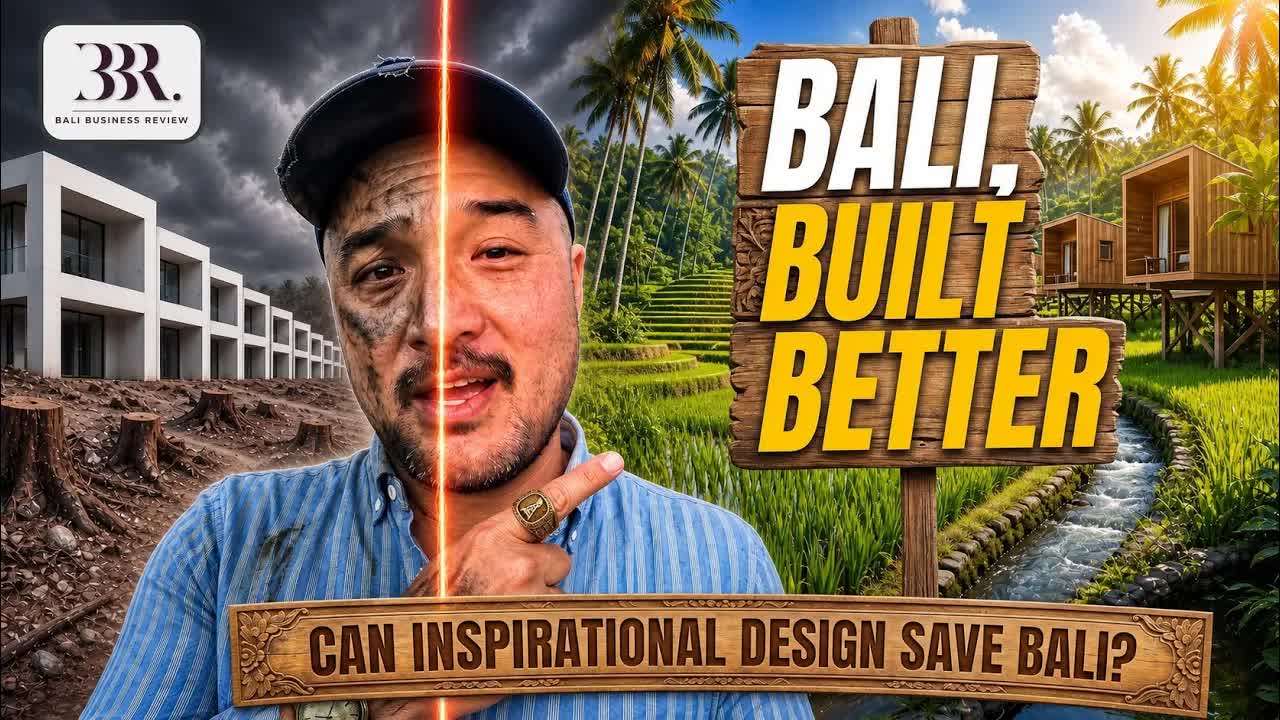
What the reporting suggests
Better Bali development starts with the place: protect existing trees and water systems, design for shade and ventilation, use materials intelligently, reduce waste and create an experience rooted in local landscape and culture. The commercial case is differentiation and durability, not a promise that every natural building earns more.
What BBR observed
The Uluwatu report documents cleared land, Mediterranean-style repetition, construction pressure and luxury development beside environmental damage. It asks what capital is building beyond a marketable image.
The JIA Curated, bamboo and eco-tech episodes offer alternatives: rooms among trees, passive heat management, circular materials, water and waste attention, Balinese architectural knowledge and experiential design.
Follow the evidence in the episode
- 3:46Nature as part of the architecture
The JIA Curated report describes biophilic design as integrating water, plants, stone, sound and reflection into the lived space.
- 14:08The cultural design test
The conclusion asks future development to recover a Tri Hita Karana relationship rather than copy a placeless visual trend.
Each checkpoint links to the exact video and time used for this draft. It verifies what the episode said or recorded—not every external fact mentioned in the reporting.
What authoritative records add
Current Indonesian frameworks support measurable green-building performance, sustainable destination management and source-based waste handling. They do not validate every environmental claim made in the episodes.
Green Building Performance Assessment, Regulation No. 21 of 2021
Ministry of Public Works and Housing via BPK regulations database · 1 April 2021What it supports: Provides Indonesia's current framework for assessing green-building performance.
Limit: Compliance or certification must be established for each building; visual style is not evidence.
Sustainable Tourism Destination Guidelines, Regulation No. 9 of 2021
Ministry of Tourism and Creative Economy via BPK regulations database · 7 July 2021What it supports: Establishes the national sustainable-destination framework.
Limit: It does not certify any project shown in the BBR videos.
Source-based waste management in Bali
Bali Provincial Public Works Department · 4 August 2022What it supports: Summarises Bali Governor Regulation 47/2019 duties for commercial areas and other facilities.
Limit: The page describes policy requirements, not measured compliance by a particular development.
Status: design and environmental framework checked
How to use this insight
Write the design brief around climate, guest behavior, operations and the existing site before choosing a visual style. Require the team to explain what is preserved, how heat and water are managed and why the concept belongs in Bali.
Context-responsive design can create durable differentiation.
What to monitor next
Measure energy, water, maintenance, guest review themes, construction waste, tree retention and long-term material performance. Photograph the actual spatial experience, not only decorative details.
Watch the source reporting
- Bali Is Getting Ugly. These Designers Have a Better Plan. | JIA Curated 2026 Design FestivalPublic BBR episode · 15 August 2026 · Studio-authored English captions
- Is Bali Becoming Ugly? The Hidden Cost of Its Property Boom | Market Insights Uluwatu & South BaliPublic BBR episode · 31 July 2026 · Studio-authored English captions
- Why Timeless Design Could Save Bali—and Your Investment | JIA Curated 2026 Design Festival LessonsUnlisted BBR episode · 21 August 2026 · Studio-authored English captions
- Market Insights | Bali’s Ancient Wisdom vs. Runaway Capitalism — Who Wins?Public BBR episode · 17 October 2025 · Public YouTube captions
- These Villa Designs DOMINATE Bali's Airbnb MarketPublic BBR episode · 8 May 2025 · Public YouTube captions
Sources accessed 8 September 2026. Transcript preference is Studio-authored English, then a matched editorial transcript, then public captions. The independent records above were checked separately and their limits are stated explicitly. Property-specific legal, tax and investment conclusions still require qualified professional review. This page remains demonstration content and is not approved for public indexing.